Never fly blind: a pilot's checklist for running Expert Advisors.
A backtest is a simulator. Live trading is the flight. This is the checklist I use to keep my EAs on instruments once they leave the sim.
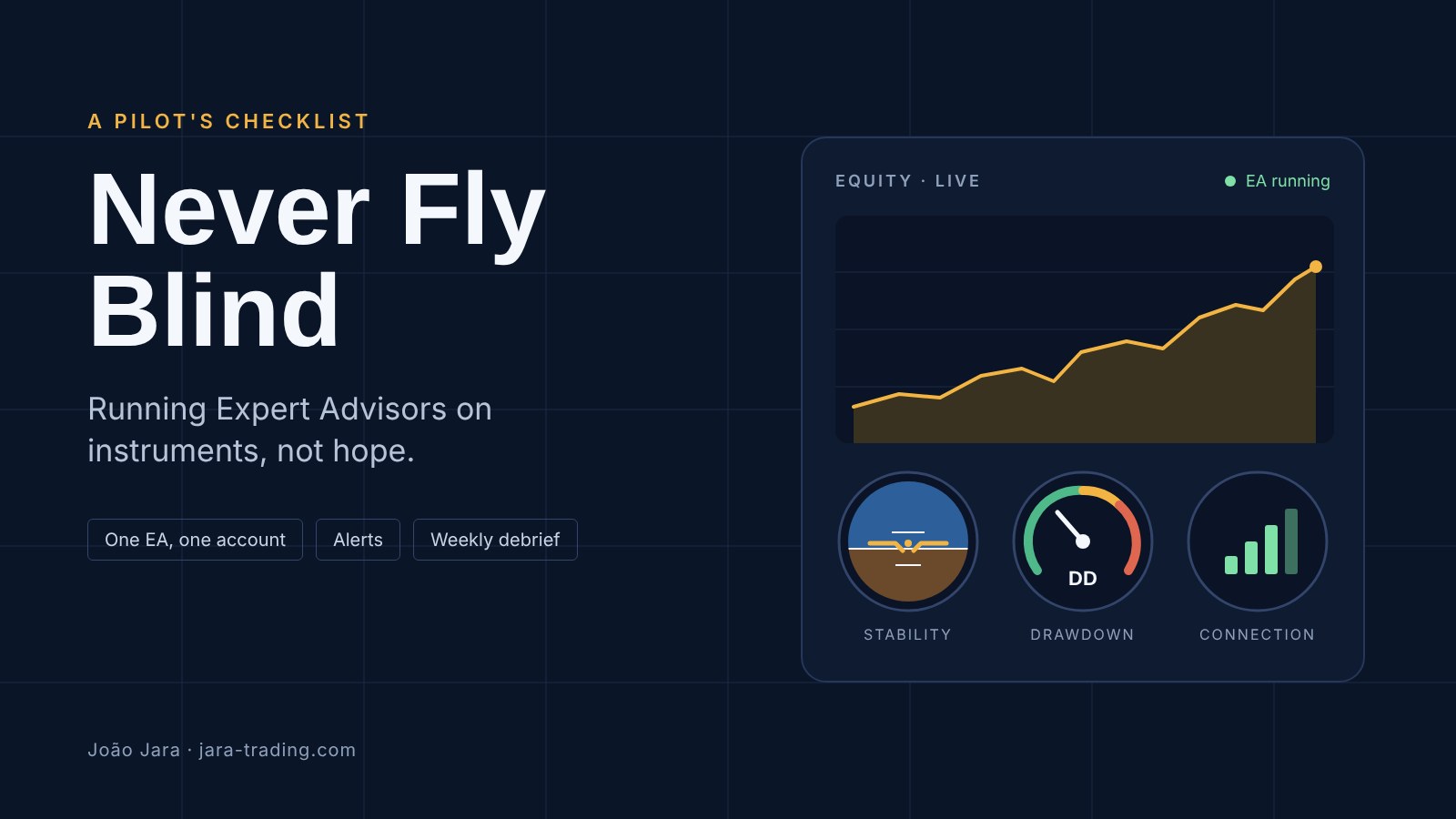
I fly the Airbus A320 for a living, and building Expert Advisors is my side project. I already wrote about what flying taught me about building trading systems. This one is about the part that comes after: running them live.
In aviation, nobody confuses the simulator with the real aircraft. The sim is where you learn the procedures and rehearse failures. But the first time you meet real weather, real traffic and a tired crew, you are on instruments, and you trust what they tell you, not what you expected.
A backtest is my simulator. It tells me whether a strategy has an edge and how it behaved in the past. It does not tell me what will happen next Tuesday when spreads widen, my VPS reboots or the market does something it never did before. That gap between the sim and the flight is where most traders get hurt.
1. One EA, one real account
On the flight deck, every system has its own gauge. If two engines shared one temperature needle, you would never know which one was failing.
I treat my EAs the same way. Each one runs on its own real account, so every equity curve, drawdown and win rate belongs to exactly one strategy. When something looks wrong, I know where to look.
Mixing several EAs on one account feels efficient, but it blurs the picture. A good week from one robot can hide a bad week from another, and you only find out when both go wrong together. I also run a combined portfolio account, but only on top of the individual ones, never instead of them.
2. Scan the instruments, not the P&L
A pilot doesn't stare at one gauge. You scan: attitude, speed, altitude, engines, then back again. I do the same with my accounts, and profit is not the first thing I look at.
- Equity vs balance: a wide gap means open risk I need to understand.
- Drawdown: current, and how close it is to the worst the backtest showed.
- Is the EA actually running: AutoTrading on, the right version loaded, no errors in the journal.
- Connection: terminal online, VPS alive, trades going through.
This is where a monitoring service earns its place. I use FX Monitor because I can't watch charts while I'm at 37,000 feet. It watches the accounts for me, and an alert reaches me when I land. The worst failures in automated trading are silent ones: an EA that stopped hours ago, a terminal that lost its connection, a drawdown creeping past its normal range. Silent failures are exactly what instruments are for.
3. When the flight teaches you something the sim didn't
Recently the indices had a sharp sell-off. Watching one of my index EAs trade through it live, I noticed something the backtest summary had never made obvious: its worst losses clustered in the days right after a volatility shock.
In aviation, when an event shows a gap, you change the procedure and test it in the sim before it flies. So I did exactly that. I added a simple crash filter: when short-term volatility jumps well above its long-term average, one of the strategies sits out. Then I backtested 2020 to 2026 with the filter off and on.
| 2020–2026 backtest | Filter off | Filter on |
|---|---|---|
| Net profit | 7,858 | 6,853 |
| Sharpe ratio | 1.37 | 1.71 |
| Max relative equity drawdown | 44.2% | 30.5% |
The filter costs about 13% of net profit. In return the deepest drawdown drops by almost a third and the risk-adjusted return improves. For me that's an easy trade: profit you never live to collect isn't worth much.
The loop
Watch the live account, notice something, go back to the simulator, test it honestly, and only then change the aircraft.
4. Debrief every week, in public
After every flight there is a debrief: what went well, what didn't, what we change. Skip it and small problems quietly become habits.
My weekly debrief is automatic. At the weekend each account posts a short report to my public Telegram channel: trades, win rate, profit and drawdown for the week. Good weeks and bad weeks go out the same way.
Doing it in public keeps me honest. It's hard to fool yourself about a strategy when its numbers are posted every week. It also gives the people who use my EAs a live track record, not just a backtest screenshot. You can see every account on the Live Results page.
Before every flight: the checklist
- One EA per real account, so every number has one owner.
- Know your backtest's worst drawdown, and alert well before you reach it.
- Confirm the EA is running: AutoTrading on, right version, clean journal.
- Monitor the connection and the VPS, not just the trades.
- Use alerts, so you don't need to be at the screen.
- When live trading surprises you, test the fix in the backtest before you change anything.
- Debrief weekly, and if you can, in public.
None of this makes a strategy profitable. What it does is make sure that when something goes wrong, and it will, you find out early and on your own terms. Pilots call that situational awareness. If you run EAs, connect your accounts to FX Monitor and give yourself a proper instrument panel. Never fly blind.
Risk disclaimer
Trading involves substantial risk of loss and is not suitable for every investor. Past performance, whether backtested or live, does not guarantee future results. Only trade with capital you can afford to lose.